Help with costs
Find schemes and funding for cancer treatment
Find government schemes, relief funds and charities that may help pay for cancer treatment in India, checked against official sources, with documents needed.
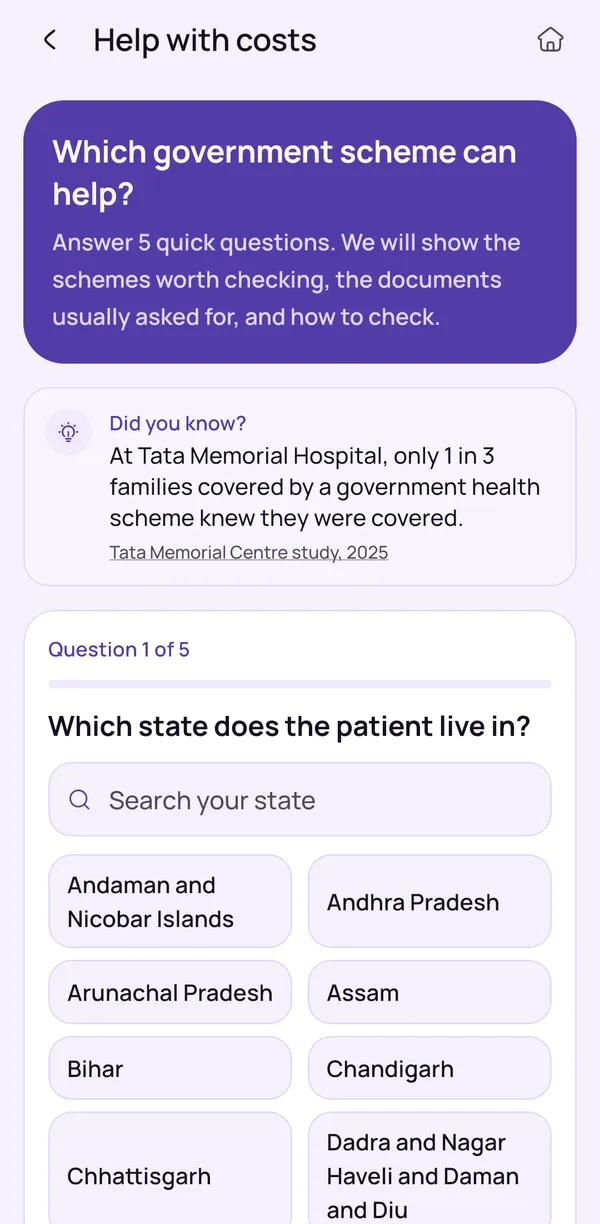
Answer 5 quick questions
OncoVOIS asks five short questions about your situation. Your answers are used only to point you towards government schemes, relief funds and charities that may be worth checking. The app does not decide for you, and it does not promise that any help will be given.
For each programme it lists, the app shows the documents usually needed and links to the official site, so you can read the current rules and apply there. This saves the time of searching many websites while you are also dealing with treatment.
Start early, because applications can take time and some need papers from the hospital. Each scheme decides who qualifies, so treat the list as a starting point.
- Five short questions about your situation
- Schemes, relief funds and charities worth checking
- Documents usually needed and a link to the official site
Government schemes, relief funds and charities
Families usually look at three kinds of help. Government schemes can be run by the central government or by a state. Relief funds include the Prime Minister's National Relief Fund and Rashtriya Arogya Nidhi. Charities and hospital funds may help with treatment or related needs.
They differ in what they cover, how to apply and who may be considered. Some work only through certain hospitals, and some ask for papers from your doctor. None can be assumed to apply to you until the scheme itself confirms it.
A good place to start is the hospital's help desk or a medical social worker, who often know which schemes the hospital works with.
- Central and state government schemes
- Relief funds
- Charities and hospital funds
Documents you will usually need
For each programme, OncoVOIS shows the documents usually asked for and links to the official site, where the exact list is given. Many schemes ask for similar papers, and some also want bank details and recent photographs.
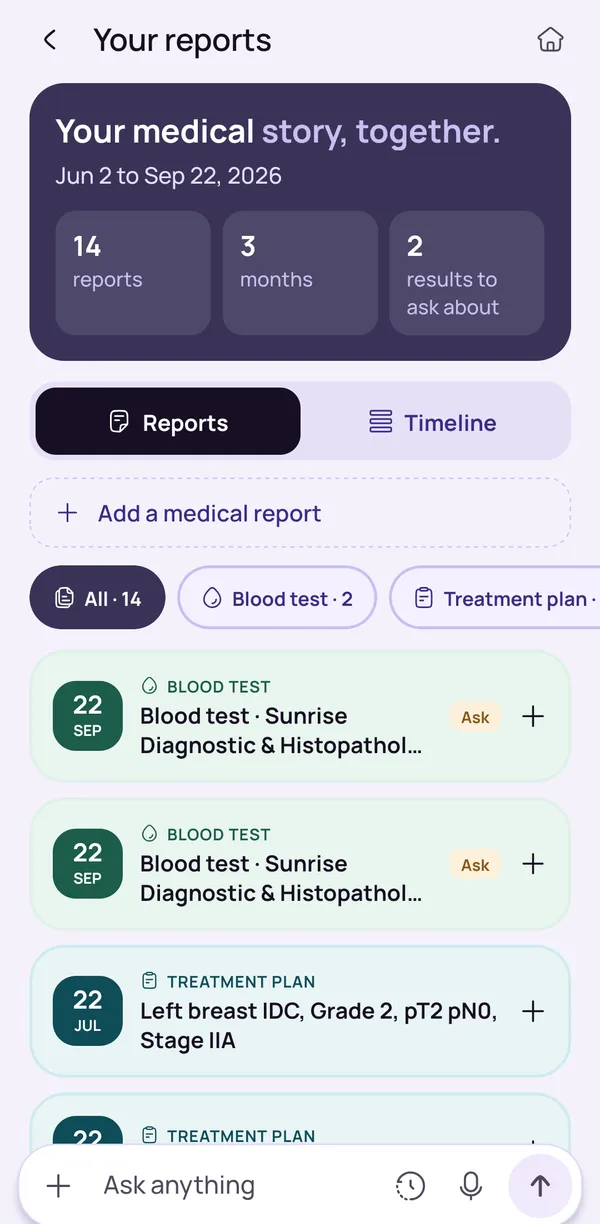
Collect copies early and keep them together, because the same papers are often needed more than once. Your medical reports are already in the app's timeline, so they are easier to find when a form asks. Many schemes also ask for a written estimate from the hospital, so ask the billing or counselling desk for one and keep it with your papers.
Rules change, so check the current list before you travel, and ask whether copies need to be attested.
- Identity and address proof
- A doctor's letter or medical report confirming the diagnosis
- A treatment plan or estimate from the hospital
- Income or category certificates, where asked
Checked against official sources
Each programme in the app has been checked by CancerFax against official sources, and the app shows the date it was last checked. Scheme rules, hospital lists and application steps change often, so no summary can be fully final.
Read the current details on the official site before you apply, or confirm with the scheme's helpline or the hospital's help desk. This matters most for which hospitals are included, which treatments are covered and which papers are needed.
If the app and the official site disagree, believe the official site, and let the CancerFax team know. Keeping a note of whom you spoke to and when can also help if a question comes up later.
- Last-checked date for each programme
- A link to the official site
Each scheme decides who qualifies
OncoVOIS cannot tell you whether you qualify, approve an application or say how much a scheme will pay. Rules can depend on the state, the hospital, the type of treatment and your documents, and they change. If one programme does not apply, another may, so it is worth reading through the list.
The app does not diagnose or recommend treatment either, and your oncologist decides on your care. Confirm the details with the scheme or the hospital's help desk.
Be careful with anyone who asks for money to arrange a scheme, and check with the hospital or the official site before paying anything.
- A hospital help desk or medical social worker can help with forms
- If told no, ask why and whether another fund can be tried
Keep reading
Read more
Plain-words guides on this topic, for patients and families.
- Plain-words guideHow AI Helps Cancer Patients Find Government Schemes and Financial SupportThe main government schemes for cancer patients in India, from Ayushman Bharat to state schemes and relief funds: who can apply and the documents needed.Read the guide
- Plain-words guideAyushman Bharat and Cancer Treatment: What to Know Before You ApplyDoes Ayushman Bharat cover cancer treatment? What PM-JAY generally covers, who may qualify, the documents usually needed and how to check at the hospital.Read the guide
- Plain-words guideRashtriya Arogya Nidhi and the PM Relief Fund for Cancer TreatmentWhat Rashtriya Arogya Nidhi and the Prime Minister’s National Relief Fund are, who may apply for cancer treatment help, how to apply and what to prepare.Read the guide
- Plain-words guideState Government Schemes for Cancer Patients: How They Differ and How to Find YoursHow state government schemes for cancer patients differ across India, who may qualify, the documents usually needed and where to check your state’s rules.Read the guide
- Plain-words guideFree Cancer Treatment in India: What Options Exist and How to Find ThemWhat “free” cancer treatment can mean in India: government hospitals, schemes and charities, what is usually covered, and how to check before you rely on it.Read the guide
Frequently asked questions
Is there financial help for cancer patients in India, and where do I start?
Yes, several kinds of help exist in India, including government schemes at central and state level, relief funds, hospital funds and charities. Which of them may help depends on the person, the hospital, the state and the type of treatment, and each programme sets its own rules.
A good place to start is the hospital's help desk or a medical social worker, who often know which schemes the hospital works with. OncoVOIS also offers a short set of questions to see which government schemes, relief funds and charities may be worth checking for you. For each one, it shows the documents usually needed and links to the official site. Start early, because applications can take time and some need papers from the hospital. Schemes change, so always confirm the latest details on the official site or with the hospital before you rely on any of them.
How does OncoVOIS help me find schemes for cancer treatment costs?
OncoVOIS asks a short set of questions about your situation and then lists the government schemes, relief funds and charities that may be worth checking. It does not decide for you and it does not promise that any help will be given.
Each programme in the app has been checked by CancerFax against official sources. The app shows the documents that are usually asked for and a link to the official site, so you can read the current rules and apply there. It also shows when each programme was last checked, because scheme details can change. This saves families the time of searching many websites while they are also dealing with treatment. Each scheme decides who qualifies, so use the list as a starting point, then confirm with the scheme itself or the hospital's help desk before you plan around it.
What kinds of help can a family look at for cancer treatment?
Families usually look at three groups. The first is government schemes, which can be run by the central government or by a state. The second is relief funds, such as the Prime Minister's National Relief Fund and Rashtriya Arogya Nidhi. The third is charities and hospital funds, which may help with treatment or related needs.
These differ in what they cover, how to apply and who may be considered. Some work only through certain hospitals, and some ask for papers from your doctor. None can be assumed to apply to you until the scheme itself confirms it. OncoVOIS helps you see which of these may be worth checking, shows the documents usually needed, and links to the official site. For detailed questions about one scheme, the official site or the hospital's help desk can explain how it works and whether your treatment is covered.
What documents are usually needed to apply for cancer financial assistance?
The list differs by scheme, but many ask for similar papers. These often include identity proof, address proof, a medical report or doctor's letter that confirms the diagnosis, a treatment plan or estimate from the hospital, and income or category certificates where the scheme asks for them. Some also want bank details and recent photographs.
A good habit is to collect copies early and keep them together, because the same papers are often needed more than once. For each programme it lists, OncoVOIS shows the documents usually asked for and links to the official site, where the exact list is given. Since your medical reports are already in the app's timeline, they are easier to find when a form asks for them. Rules change, so check the current list on the official site or with the hospital's help desk before you travel, and ask whether copies need to be attested.
How do I know the scheme information is correct and up to date?
Scheme rules, hospital lists and application steps change often, so no summary can be fully final. In OncoVOIS, each programme is checked by CancerFax against official sources, and the app shows the date it was last checked. It also links to the official site, which is the place to read the current rules.
Treat the app as a way to find programmes worth checking, not as the last word. Before you apply, confirm the details with the scheme's own website or helpline, or with the hospital's help desk, especially for questions about which hospitals are included, which treatments are covered and which papers are needed. If the app and the official site disagree, believe the official site, and let the CancerFax team know. Keeping a note of whom you spoke to and when can also help if a question comes up later.
Will the app tell me if I qualify for a scheme?
No. OncoVOIS can show you schemes, relief funds and charities that may be worth checking, but each scheme decides who qualifies. The app does not approve applications and cannot promise that you will receive help.
The short set of questions it asks is only used to point you towards programmes that may fit. After that, the official site or the scheme's office gives the real answer. This matters because rules can depend on the state, the hospital, the type of treatment and your documents, and they can change. If one programme does not apply, another may, so it is worth reading through the list. If you are told no, ask the reason and whether you can apply again, or whether another fund can be tried. The hospital's help desk or a medical social worker can often explain next steps and help with forms.
Can I get financial assistance for cancer treatment without insurance?
Some people can. Many government schemes, relief funds and charities exist because not every family has private health insurance. But each programme has its own rules, and some depend on your state, your documents or the hospital you attend, so it cannot be assumed that any one will apply to you.
OncoVOIS can help you see which government schemes, relief funds and charities may be worth checking, with the documents usually needed and a link to the official site. It then depends on the scheme to decide who qualifies. If you do have some insurance, mention that to the hospital's help desk too, since it may change which options are open. It is sensible to ask early, before treatment starts if possible, because some schemes need approval first. Always confirm the current rules on the official site or with the hospital, because details change over time.
Does the app tell me how much my cancer treatment will cost?
No. OncoVOIS does not give treatment cost estimates, because the real amount depends on the hospital, the type of treatment, the room, the tests and what happens during care. Any figure from an app could mislead a family.
For an estimate, ask the hospital's billing or counselling desk for a written breakdown, and ask what is included and what may be extra. Bring that paper when you check a scheme or fund, since many ask for an estimate from the hospital. The app can help you see which programmes may be worth checking, show the documents usually needed, and link you to the official site. It cannot say how much any scheme will pay. Each scheme decides what it covers and who qualifies, so confirm this with the scheme or the hospital's help desk before you plan around it. Keep the hospital's written estimate safe, because it is often needed again.
Who can help me fill in the forms and apply for a scheme?
Start with the hospital's help desk, patient counselling team or medical social worker. Many hospitals handle scheme applications often and know which papers the hospital must supply, such as a doctor's letter or an estimate. A trusted family member can then help with the rest of the form.
The official site of each scheme also explains how to apply, and many have helplines. OncoVOIS shows the documents usually needed for each programme it lists and links to the official site, so you can arrive prepared. Your reports are in one timeline in the app, which can save time when a form asks for them. Be careful with anyone who asks for money to arrange a scheme, and check with the hospital or the official site before paying anything. Compare names, forms and websites with the official site, and ask the hospital if you are unsure whether something is genuine.
This page is general information, not medical advice. OncoVOIS explains and helps you prepare; your oncologist decides about your care.