
Tests to ask about
Cancer tests and biomarkers worth asking your doctor about
See the tests and biomarkers that guidelines commonly list for your type of cancer, why each one matters, and the questions to ask your doctor.
Why biomarker tests matter for treatment
A biomarker test looks for a feature that tells doctors more about a cancer, such as a change in a gene, a protein on cancer cells, or a substance in the blood. Two people with the same type of cancer can have different results, which is one reason the same cancer is not always treated in exactly the same way.
A result may help the oncologist decide which treatments to discuss, including newer ones such as targeted therapy, which means medicines designed to act on a specific feature of cancer cells.
In many cancers the choice depends partly on a biomarker result, but not in all. A test result is one piece of a larger picture, and your oncologist decides which tests you need.
- A gene change, a protein or a substance in the blood
- Results can differ between people with the same cancer
- A result is one piece of a larger picture
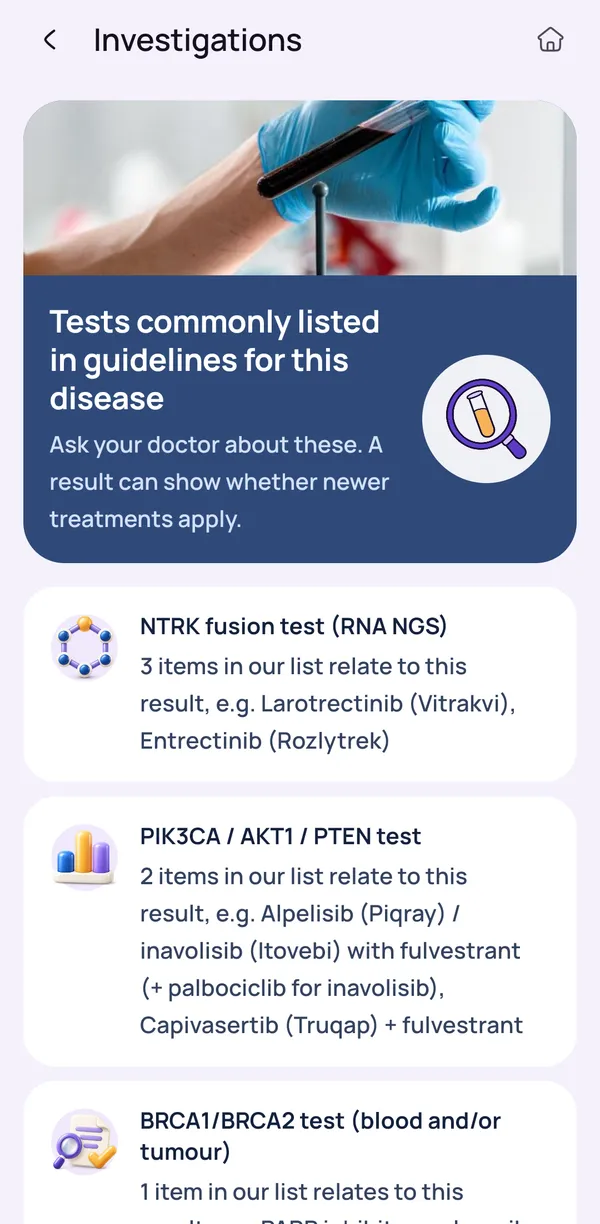
Tests commonly listed for your cancer
OncoVOIS uses a reviewed list of tests commonly mentioned in guidelines for different cancers. It matches this list to the details you confirmed from your reports, such as diagnosis and stage. Each test is labelled as something to discuss, never a recommendation, and never a judgement of the care you are receiving.
This is a general picture only, and the lists change as research moves on. Not every test applies to every person. It depends on the exact type and stage of the cancer, and sometimes on what your hospital offers.
A test may already have been done in a report you have not added, may not apply to you, or may be planned for later. The app cannot know which, so bring the list to your visit and ask.
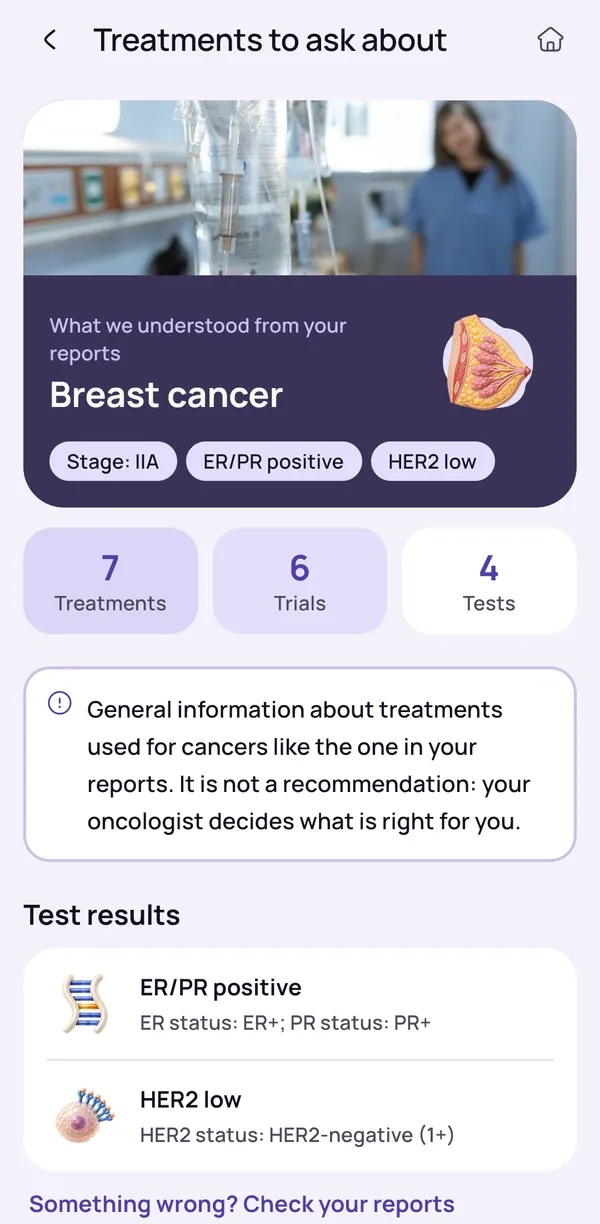
- Breast cancer: often ER, PR and HER2
- Lung cancer: often EGFR, ALK and PD-L1
- Colon cancer: often RAS, BRAF and MSI
HER2, EGFR, BRCA and other markers in plain words
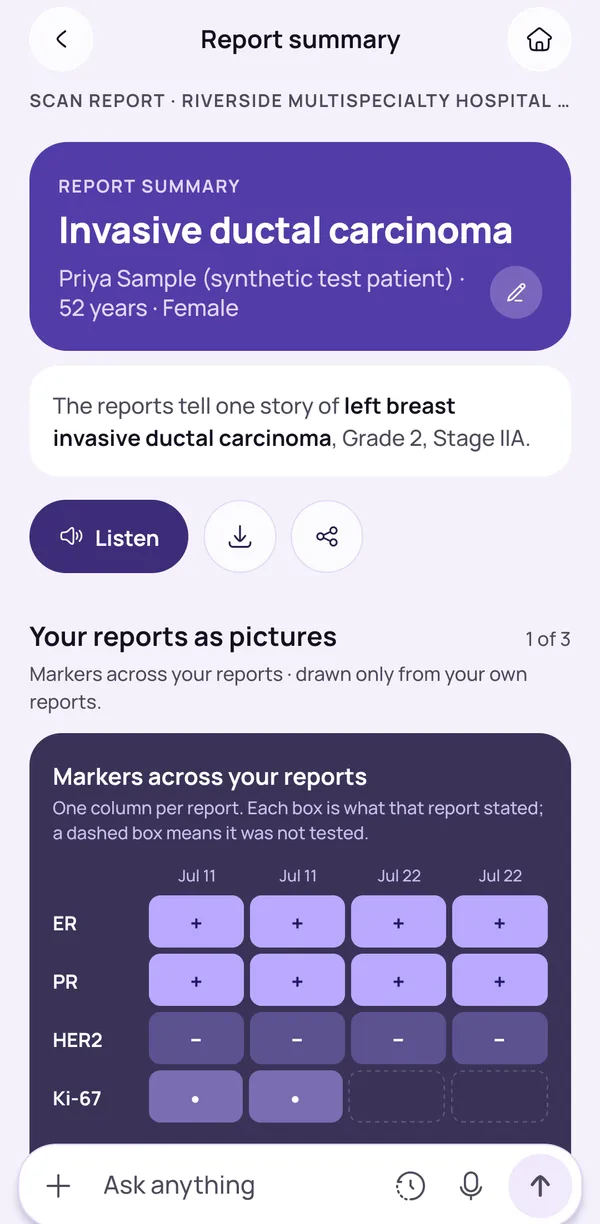
HER2 is a protein on some cancer cells that can help them grow, most often talked about in breast cancer. EGFR is a gene that can carry changes in some lung cancers. BRCA1 and BRCA2 are genes that normally help repair damaged cells, and changes in them are linked to some breast, ovarian, prostate and pancreatic cancers.
These names may appear on a report as a result, such as positive or negative. What a result means depends on the cancer and on the exact test, so be careful about reading too much into one word.
A result is not good or bad on its own, and your oncologist explains what it means for you. If one of these words appears in a report you add, the app explains hard words in plain language.
- HER2: a protein on some cancer cells
- EGFR: a gene that can change in some lung cancers
- BRCA1 and BRCA2: genes that help repair damaged cells
Turn a test into a question for your visit
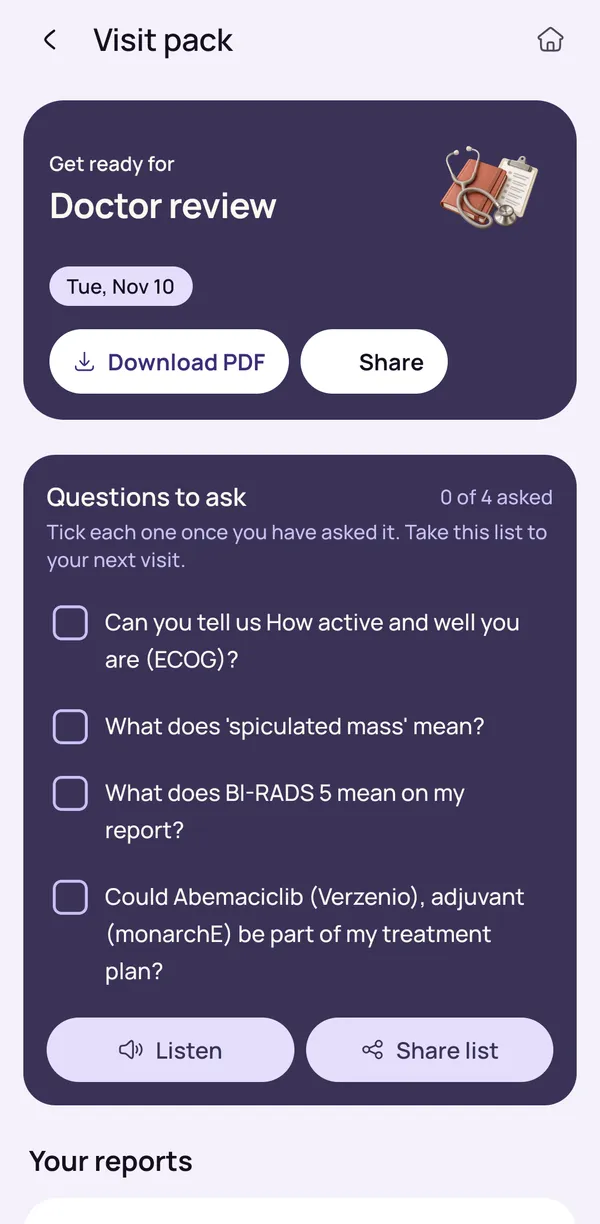
Start with the name of the test and ask a simple, open question, such as whether it is relevant to your cancer or has been done already. You can then ask what a result could mean for your treatment options.
Useful follow-up questions include why the test is or is not needed, how the sample is taken, how long the result usually takes, and who will explain the result to you. Write your questions down before the visit, because it is easy to forget them in a short appointment.
The visit pack holds them in a short list you can tick off, read aloud, download as a PDF or share with family.
- Is this test relevant to my cancer?
- Has it been done, and where is the result?
- Could the result change what we discuss?
Your doctor decides which tests you need
Your doctor decides which tests are needed. OncoVOIS helps you find tests worth asking about, but it does not order tests, diagnose, or decide who needs them.
A test may already be done, may be planned, or may not apply to you. Cancer care depends on the type of cancer, the stage and your general health, so a test that matters for one person may not matter for another. If your reports show no biomarker results, please do not assume anything from an empty space. Ask your oncologist.
If your doctor says a test is not needed, that is a valid answer, and it is fine to ask why. Ask the doctor to explain the reason in plain words.
- Suggestions are only for discussion
- The app does not order tests or diagnose
- It is fine to ask why a test is not needed
Keep reading
Read more
Plain-words guides on this topic, for patients and families.
- Plain-words guideHow AI Helps You Find Cancer Tests and Biomarkers Worth Asking AboutWhat a biomarker test is, how it differs from a tumour marker test, what HER2, EGFR and BRCA results mean, and which tests are worth asking about.Read the guide
- Plain-words guideTumor Marker Tests Explained: CA 125, CEA, PSA and CA 15-3What tumor marker tests such as CA 125, CEA, PSA and CA 15-3 measure, why levels can change for other reasons, and what to ask your oncologist.Read the guide
- Plain-words guideHER2 Test Meaning: Positive, Negative and HER2-Low ExplainedWhat a HER2 test measures, what positive, negative and HER2-low results can mean in breast cancer, and what to ask your oncologist about your report.Read the guide
Frequently asked questions
What is biomarker testing for cancer, and why do doctors ask for it?
A biomarker test looks for a feature in the body that tells doctors something about a cancer. It may be a change in a gene, a protein on the surface of cancer cells, or a substance in the blood. Doctors ask for these tests because a result can help them understand the cancer more closely.
Two people with the same type of cancer can have different biomarker results. That is one reason the same type of cancer is not always treated in exactly the same way. A result may help the oncologist decide which treatments to discuss with you.
Which tests are needed depends on the type of cancer, the stage and your own situation. Your oncologist decides which tests you need. If you are curious about a test you have read about, you can ask. OncoVOIS helps you find tests worth asking about, but it does not order tests or decide who needs them.
How can a biomarker result change cancer treatment options?
A result can show that a cancer has a feature that certain treatments are designed to act on. When that feature is found, newer treatments such as targeted therapy or immunotherapy may become options to discuss. When it is not found, those options may not apply, and the oncologist may focus on others.
Targeted therapy means medicines designed to act on a specific feature of cancer cells. Immunotherapy means treatment that helps the body's own defence system respond to cancer. In many cancers, the choice depends partly on a biomarker result, but not in all. This is general information, not advice for your case. Whether a result opens any option for you depends on your cancer type, stage, general health and what your oncologist finds suitable. A test result is one piece of a larger picture. You can use the result as a starting point for a question: does this result change what we discuss for my treatment? Your oncologist is the right person to answer.
Which biomarker tests are commonly listed for breast, lung and colon cancer?
Guidelines commonly list different tests for different cancers. For breast cancer, hormone receptor tests (ER and PR, which check whether cancer cells respond to the hormones oestrogen and progesterone) and HER2 are often mentioned. For lung cancer, tests such as EGFR, ALK and PD-L1 are often mentioned. For colon cancer, tests such as RAS, BRAF and MSI (a check of how the cancer cells repair their genes) are often mentioned.
This is a general picture only, and the lists change as research moves on. Not every test applies to every person. It depends on the exact type and stage of the cancer, and sometimes on what your hospital offers.
OncoVOIS matches tests commonly listed in guidelines to your reports, from a reviewed list, and labels each as something to discuss. It is not a recommendation. Bring the list to your visit and ask which tests apply to you, which are already done, and which are planned.
What do HER2, EGFR and BRCA mean in plain words?
HER2 is a protein on some cancer cells that can help them grow, and HER2 testing is most often talked about in breast cancer. EGFR is a gene that can carry changes in some lung cancers. BRCA1 and BRCA2 are genes that normally help repair damaged cells, and changes in them are linked to some breast, ovarian, prostate and pancreatic cancers.
These names may appear on a report as a result, such as positive or negative. What a result means depends on the cancer and on the exact test, so be careful about reading too much into one word. A result is not good or bad on its own. Your oncologist explains what it means for you.
For a closer look at HER2, see the HER2 guide on this site. If one of these words appears in a report you have added to OncoVOIS, the app explains hard words in plain language, and your oncologist remains the right person to explain the result.
Where does the list of tests in OncoVOIS come from?
OncoVOIS uses a reviewed list of tests that are commonly mentioned in guidelines for different types of cancer. It matches this list to your reports and shows the tests as items to discuss with your doctor.
You first review what the app found in your reports, and nothing is saved until you confirm it. The suggestions follow from the confirmed details, such as the diagnosis and stage. If the app is not sure about a detail, it says so and asks you to confirm it. Each test is labelled as something to discuss. It is never a recommendation, and it is not a judgement of the care you are receiving. A test may already have been done in a report you have not added, may not apply to your situation, or may be planned for later. The app cannot know which. Guidelines change over time and differ between countries and hospitals. Your oncologist decides which tests you need.
How do I turn a test into a question for my oncologist?
Start with the name of the test and ask a simple, open question. For example: is this test relevant to my cancer? Or: has this test been done, and where can I find the result? You can then ask what a result could mean for your treatment options.
Useful follow-up questions include why the test is or is not needed, how the sample is taken, how long the result usually takes, and who will explain the result to you. Write the questions down before the visit, because it is easy to forget them in a short appointment. OncoVOIS has a visit pack, a short list of questions for the next visit that can be ticked off, read aloud, downloaded as a PDF or shared with family. You can use it to carry your questions to the appointment. The oncologist may answer that a test is not needed for you. That is a valid answer, and it is fine to ask why.
Is it all right to ask my oncologist about a test I read about?
Yes. Asking is a normal part of your care, and doctors are used to questions from patients and families. A polite, simple question is enough, such as: I read about this test, could it apply to my cancer?
The doctor may tell you that the test has already been done, that it is planned, or that it is not needed in your situation. Each of these can be a reasonable answer. Cancer care depends on the type of cancer, the stage and your general health, so a test that matters for one person may not matter for another. Try to bring the report or the name of the test, and where you read about it. Ask the doctor to explain the reason in plain words. If you are not sure you understood, ask the doctor to repeat it or write it down. OncoVOIS suggestions are only for discussion. Your doctor decides which tests are needed.
Is a biomarker test done on a biopsy sample or on blood?
It can be either, depending on the test. Many biomarker tests are done on a tissue sample from the tumour, taken during a biopsy or an operation. Some are done on a blood sample. Your doctors choose the type of sample that suits the test.
A biopsy means a small piece of tissue taken from the body and examined in a laboratory. The laboratory may run extra tests on the same tissue after the first report is made, so a biomarker result may come in a separate report, sometimes later than the main biopsy report. Blood tests used for biomarkers are different from routine blood counts such as haemoglobin, and a sample for a biomarker may need to go to a specialised laboratory. If you are unsure what sample your test needs, ask your oncologist or the laboratory. If a biomarker result is in a report you add to OncoVOIS, the app shows what it found and you check it.
What if my reports show no biomarker results?
It does not always mean that anything is wrong or that a test was skipped. A biomarker result can be in a separate report, added later by the laboratory. The test may not apply to your type of cancer. Or the report you have may simply be a different kind, such as a scan.
Reports are often spread across hospitals and laboratories, so it helps to add all of them. OncoVOIS puts the reports you add in one timeline and shows what it found in each. If a biomarker result is in a report you have not added, the app cannot show it. If you still cannot find one, ask your oncologist or the hospital records desk. A useful question is: have any biomarker tests been done for my cancer, and where is the result? The doctor may say that none are needed, that one is planned, or that the result is on its way. Please do not assume anything from an empty space in a report. Let your oncologist explain.
This page is general information, not medical advice. OncoVOIS explains and helps you prepare; your oncologist decides about your care.