
Treatment options
Cancer treatment options matched to your reports
See standard and newer cancer treatment options linked to your reports, including immunotherapy and targeted therapy, to discuss with your oncologist.
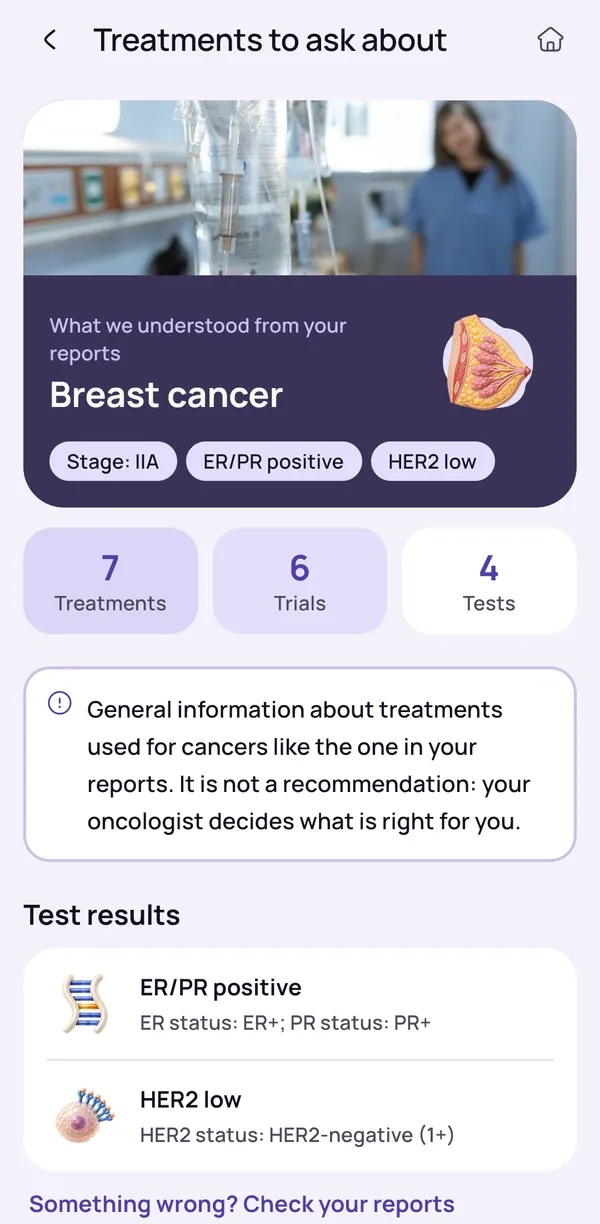
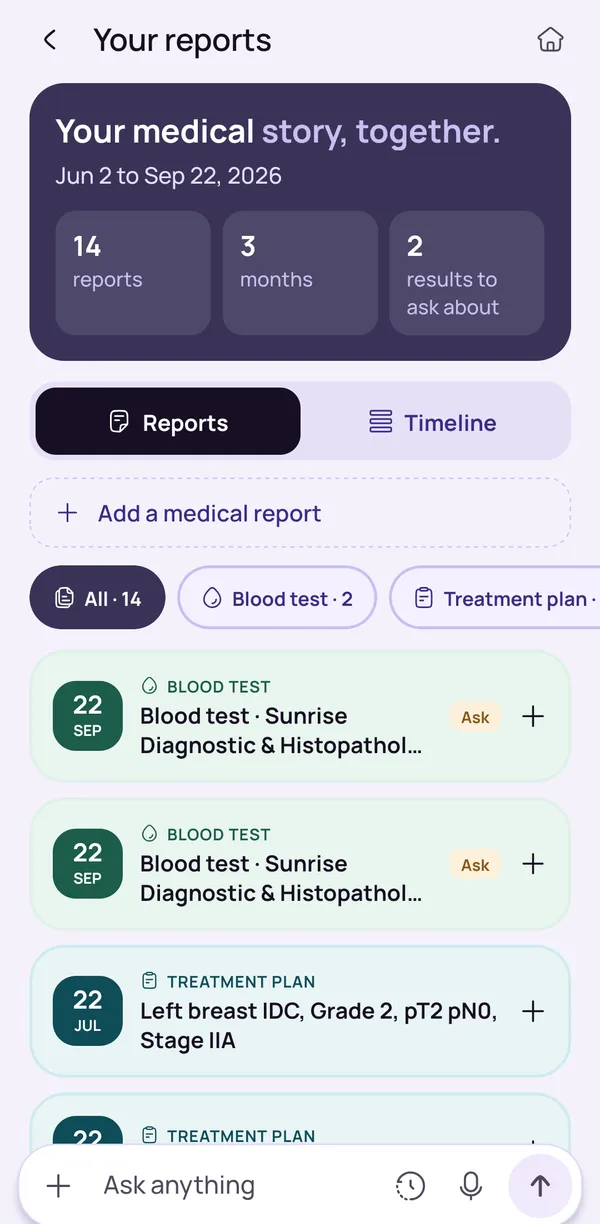
How options are matched to your reports
OncoVOIS reads the reports you add, such as a biopsy, scan or blood test, and shows what it found. Nothing is saved until you confirm. It then matches the confirmed details to a reviewed list of treatments commonly discussed for that type of cancer.
The options come from that list, not from the AI making them up, and the app says when it is not sure and asks you to confirm details. If something important is missing from your reports, a test that guidelines commonly list may be shown for you to ask about.
The more complete your saved reports are, the more complete the matching can be. You can also use Ask to put a question about an option in your own words, by typing or speaking.
- Matched from a reviewed list
- More complete reports mean more complete matching
- Use Ask to put a question in your own words
Standard treatments
Cancer treatment often includes surgery, radiotherapy, chemotherapy and hormone therapy. Surgery removes the tumour. Radiotherapy uses high-energy rays to destroy cancer cells in one area. Chemotherapy is medicine that acts on cancer cells all over the body, and hormone therapy blocks hormones that feed some cancers.
Many people have more than one, in a planned order, and palliative care, which focuses on comfort and relief of symptoms, can be given alongside.
Which apply depends on the type of cancer, its stage, markers in the tumour, general health and what the family wants from treatment. The list that fits one person can be very different from the list that fits another, so your oncologist explains which options are relevant and why.
- Surgery removes the tumour
- Radiotherapy uses high-energy rays in one area
- Chemotherapy acts on cancer cells all over the body
- Hormone therapy blocks hormones that feed some cancers
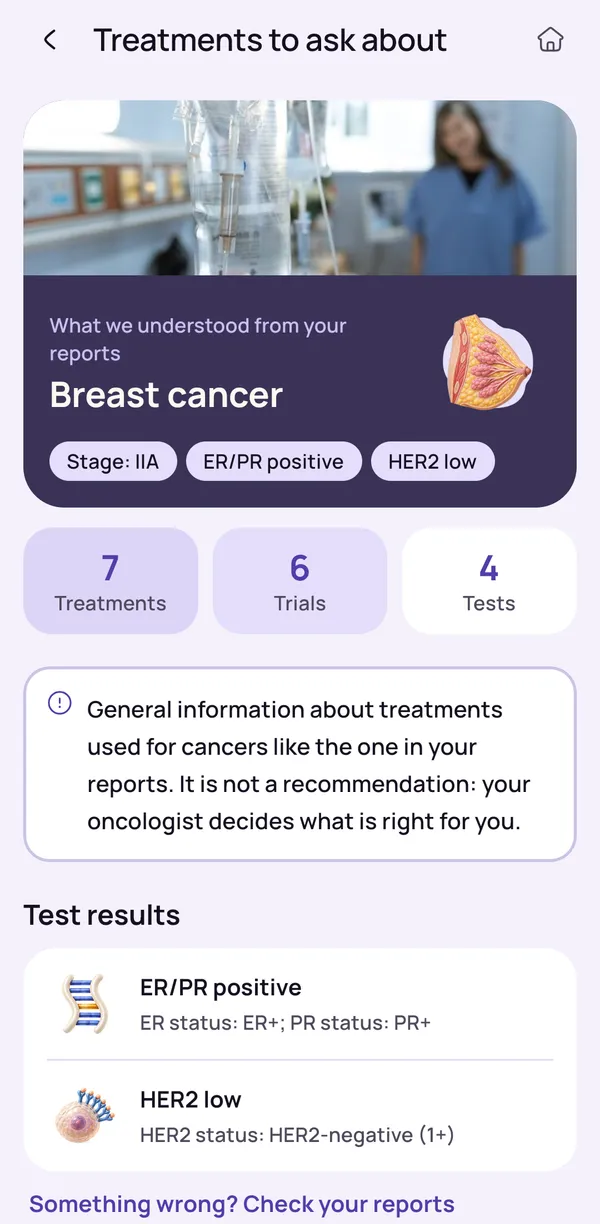
Newer options: immunotherapy and targeted therapy
Targeted therapy means medicines designed to act on a specific feature of cancer cells, and immunotherapy helps the body's own defence system respond to cancer. They are used for certain cancers in India, as in many other countries.
Whether either is relevant depends on the cancer type, stage, markers and health, so there is no single answer for everyone. Headlines about breakthroughs do not always apply to a particular patient, and some new treatments are still being studied in clinical trials.
OncoVOIS can show newer options when your reports suggest they may be worth asking about, always labelled as something to discuss. Ask your oncologist whether a newer treatment has been considered for you, and if not, why.
- Targeted therapy acts on a specific feature of cancer cells
- Immunotherapy helps the body's defence system respond
- Ask whether a newer option was considered, and why
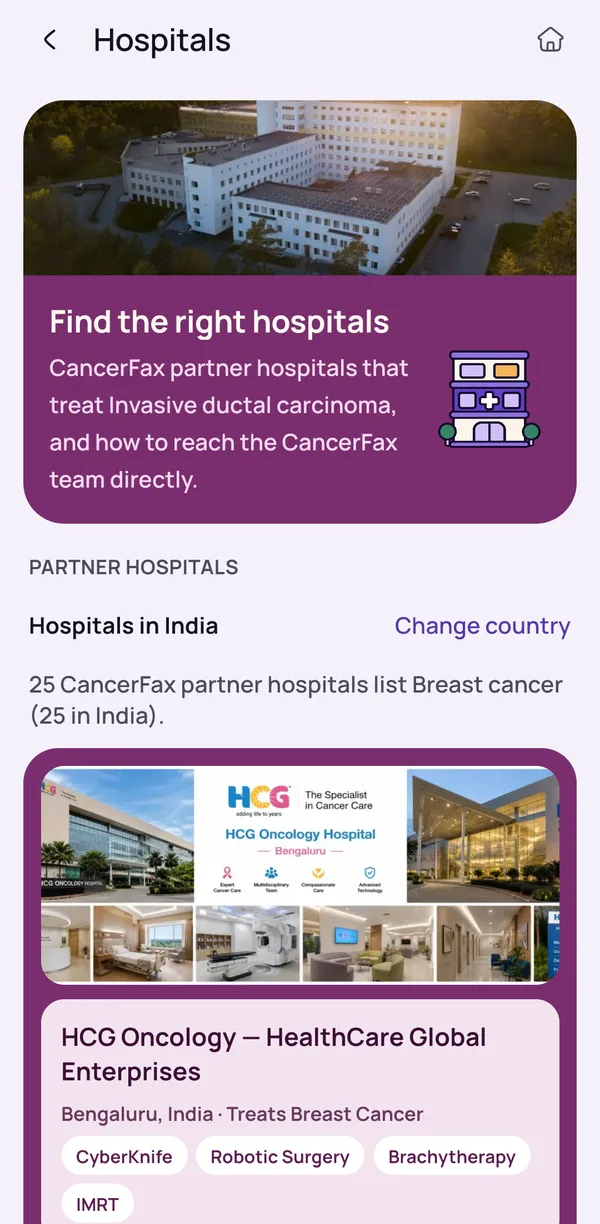
Advanced treatments and care abroad with CancerFax
The app can also point to options available through CancerFax partner hospitals in other countries. Hospitals are shown by country, and you can message the CancerFax team on WhatsApp to talk about them.
These are options to discuss, not a recommendation to travel or change hospital. Treatment abroad involves practical questions such as travel, stay, follow-up care at home and who will coordinate with your current oncologist. Many families find it useful to ask their own oncologist whether such an option is likely to add anything to the plan already suggested.
You can also ask CancerFax's senior cancer specialists to review your reports. Your own doctor stays in charge throughout.
- Partner hospitals shown country by country
- Message the CancerFax team on WhatsApp
- Ask CancerFax's senior cancer specialists to review your reports
Your oncologist decides
The treatments shown are options to discuss, not a recommendation: OncoVOIS does not diagnose or tell anyone which treatment to take, and your oncologist decides what is suitable for you. Your oncologist knows things the app cannot see, such as how you are feeling, your other health conditions and what matters most to you.
If their plan differs from the app, treat it as a reason to ask questions, not a sign that someone is wrong. Ask why this treatment was chosen and which other options were considered. If you still feel unsure, you can ask for a second opinion.
Never stop or change treatment because of an app. If you have urgent symptoms, call your hospital or 112 (ambulance 108).
- Why was this treatment chosen for me?
- Which other options were considered, and why not?
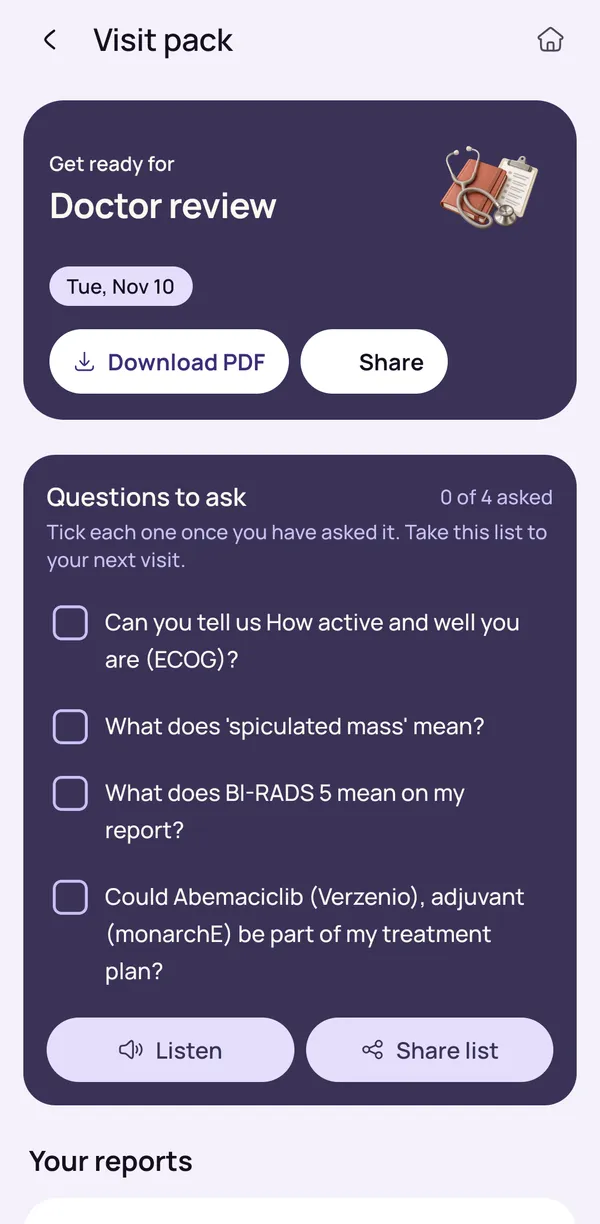
- Add your questions to the visit pack
Keep reading
Read more
Plain-words guides on this topic, for patients and families.
- Plain-words guideHow AI Uses Cancer Stage and Biomarkers to Find Relevant Treatment OptionsHow cancer stage (TNM) and biomarkers like HER2 or EGFR change which treatments may apply, including targeted therapy, explained in plain words.Read the guide
- Plain-words guideCancer Staging Explained: Stages 1 to 4 and the TNM SystemWhat cancer stages 1 to 4 and the TNM system mean, how stage differs from grade, and why staging helps your oncologist plan treatment. In plain words.Read the guide
- Plain-words guideImmunotherapy for Cancer: How It Works and What to Ask Your OncologistHow immunotherapy works against cancer, the main types, who may be considered for it, common side effects and what to ask your oncologist. In plain words.Read the guide
Frequently asked questions
What are the main cancer treatment options?
Cancer treatment options usually include surgery, radiotherapy, chemotherapy, hormone therapy, targeted therapy and immunotherapy. Which of these may apply depends on the type of cancer, its stage, markers found in the tumour, the person's general health and what the family wants from treatment.
Surgery removes the tumour. Radiotherapy uses high-energy rays to destroy cancer cells in one area. Chemotherapy is medicine that acts on cancer cells all over the body. Hormone therapy blocks hormones that feed some cancers. Targeted therapy and immunotherapy are newer kinds of medicine. Many people have more than one treatment, in a planned order. Palliative care, which focuses on comfort and relief of symptoms, can also be given alongside other treatment. The list that fits one person can be very different from the list that fits another, so the oncologist, the cancer specialist treating the patient, is the right person to explain which options are relevant and why.
How does OncoVOIS match cancer treatment options to my reports?
OncoVOIS reads the reports you add, such as a biopsy, scan or blood test, and shows what it found so you can check it. Nothing is saved until you confirm. It then matches the confirmed details to a reviewed list of treatments that are commonly discussed for that type of cancer.
The options come from that reviewed list, not from the AI making them up. The app says when it is not sure and asks you to confirm details. If something important is missing from your reports, a test that guidelines commonly list may be shown for you to ask about. Every option is labelled as something to discuss with your oncologist. The more complete your saved reports are, the more complete the matching can be. You can also use Ask to put a question about an option in your own words, by typing or speaking.
Is the treatment list a recommendation for my cancer?
No. The treatments shown are options to discuss with your oncologist, not a recommendation. OncoVOIS does not tell anyone which treatment to take, and it does not decide what is suitable for a particular person.
This is why every option carries the same label: something to discuss. Your oncologist knows things the app cannot see, such as how you are feeling, your other health conditions, the results of your latest examination and what matters most to you and your family. A treatment that appears on the list may not suit your situation, and a treatment that does not appear may still be worth raising. Use the list to prepare better questions for your visit. You can add them to a visit pack, a short list of questions you can tick off, read aloud or share with family. The decision stays with you and your oncologist.
Are there cancer treatment options other than chemo?
Yes, for many cancers. Chemotherapy is only one of several treatments. Others include surgery, radiotherapy, hormone therapy, targeted therapy and immunotherapy. Some people have one of these alone, and some have a combination.
Whether a treatment other than chemotherapy is possible depends on the type of cancer, how far it has spread, markers in the tumour and the person's general health. For some cancers chemotherapy is an important part of treatment, and for others it may not be needed at all. That is a medical judgement for the oncologist, not something the app can decide. If you add your reports, OncoVOIS can show treatments from a reviewed list that match what the reports say, each labelled as something to discuss. You can then ask your oncologist why one treatment was chosen, whether another option was considered, and whether the aim is to remove the cancer, control it or ease symptoms.
What is new cancer treatment in India, and how do I find out?
Newer cancer treatments, such as targeted therapy and immunotherapy, are used for certain cancers in India as in many other countries. Whether any newer option is relevant depends on the cancer type, its stage, markers in the tumour and the person's health, so there is no single answer for everyone.
Headlines about breakthroughs do not always apply to a particular patient, and some new treatments are still being studied in clinical trials. Clinical trials in India follow national rules and need ethics committee approval, and the trial team explains the details. OncoVOIS can show newer options from a reviewed list when your reports suggest they may be worth asking about, always labelled as something to discuss. Ask your oncologist whether a newer treatment has been considered for you, and if not, why. A second view from another specialist can also help.
What are the cancer treatment options for elderly patients?
Age alone does not decide the treatment. For older patients, the oncologist usually looks at the type and stage of the cancer, general fitness, other health conditions such as diabetes or heart problems, the medicines already being taken and what the patient wants from treatment.
Some older people can have the same treatments as younger people. Others may be offered gentler options, a different schedule or care focused on comfort. This varies a great deal from person to person, so it is worth asking the oncologist how age and other illnesses were considered. It also helps if a family member attends the visit and writes down the answers. OncoVOIS can match treatments from a reviewed list to the reports you add and read the summaries aloud, which many older people find easier. Every option is labelled as something to discuss, and the oncologist decides what is suitable.
Does OncoVOIS show treatment options in other countries?
Yes. Besides standard and newer treatments, the app can also point to options available through CancerFax partner hospitals in other countries. Hospitals are shown by country, and there is a way to message the CancerFax team on WhatsApp if you want to talk about them.
These are options to discuss, not a recommendation to travel or to change hospital. Treatment abroad involves practical questions such as travel, stay, follow-up care at home and who will coordinate with your current oncologist. Many families find it useful to ask their own oncologist whether such an option is likely to add anything to the plan already suggested. You can also ask CancerFax's senior cancer specialists to review your reports. Your own doctor stays in charge of your treatment throughout. The Hospital Finder page explains how partner hospitals are shown in more detail. If symptoms are urgent, do not wait for the app: contact your hospital or call 112.
What if my oncologist suggests something different from the app?
That is quite common, and your oncologist's advice comes first. The app shows treatments from a reviewed list that match your reports, but it cannot examine you, and it does not know everything about your health or your wishes.
If the plan differs from what you saw, treat it as a reason to ask questions, not as a sign that someone is wrong. You could ask why this treatment was chosen, which other options were considered and why they were not preferred, and what the plan would change if your tests change. Writing these questions in a visit pack helps you remember them. If you still feel unsure, you can ask for a second opinion, and CancerFax's senior cancer specialists can review your reports while your own doctor stays in charge. Never stop or change treatment on your own because of what an app shows. If you have urgent symptoms, contact your hospital or call 112, and call 108 for an ambulance.
This page is general information, not medical advice. OncoVOIS explains and helps you prepare; your oncologist decides about your care.